42 Front Door Wreath Designs That Stay Beautiful Year-Round
Disclosure : This post may contain affiliate links or paid partnerships. I may earn compensation if you click a link or make a purchase, at no additional cost to you. See my disclosure for more info.
You’ve probably thought about your front door more than you’d like to admit.
Not obsessively. But in that passing way where you walk up to it every day and feel like something’s slightly off. Like there’s something missing that you haven’t gotten around to fixing yet.
Usually, that something is a wreath.
Not a seasonal one that goes up in October and comes down in January. Not a Christmas arrangement that makes March feel like you’re still living in December. A year-round wreath. One that belongs on your door the way a good chair belongs in a room — not for an occasion, but permanently.
These 42 designs solve that problem.
Why the Seasonal Rotation Isn’t Working
The average person who decorates their door seasonally gets about three months of intentional entrance decor per year.
October through early November. The Christmas window. Maybe a brief spring attempt.
That’s twelve to fourteen weeks out of fifty-two.
The other thirty-eight weeks? The door is just a door.
The problem isn’t motivation — you’re clearly interested, or you wouldn’t be here. The problem is the approach. Buying wreaths tied to seasons means buying wreaths with built-in expiry dates.
The solution is choosing a wreath designed around material quality, neutral color, and timeless form rather than seasonal symbolism. When a wreath’s appeal comes from what it is rather than what it represents, the calendar stops mattering.
Every design on this list was chosen with that principle in mind.
Greenery Foundations That Stay Beautiful
1. Preserved eucalyptus wreath
The case for eucalyptus is simple: the color works with everything, the texture is interesting at close range and clean at distance, and preserved varieties hold for a full year without maintenance. It is the most versatile year-round wreath material available.
2. Boxwood round wreath
Boxwood solves the year-round problem through sheer consistency. The deep, even green is inherently non-seasonal. The dense form is architecturally satisfying. It requires no special context to look appropriate.
3. Mixed fern wreath
Multiple fern varieties layered together solve the visual monotony problem of single-material wreaths. The depth and tonal variation within a consistent green palette means this reads as rich and alive regardless of the month.
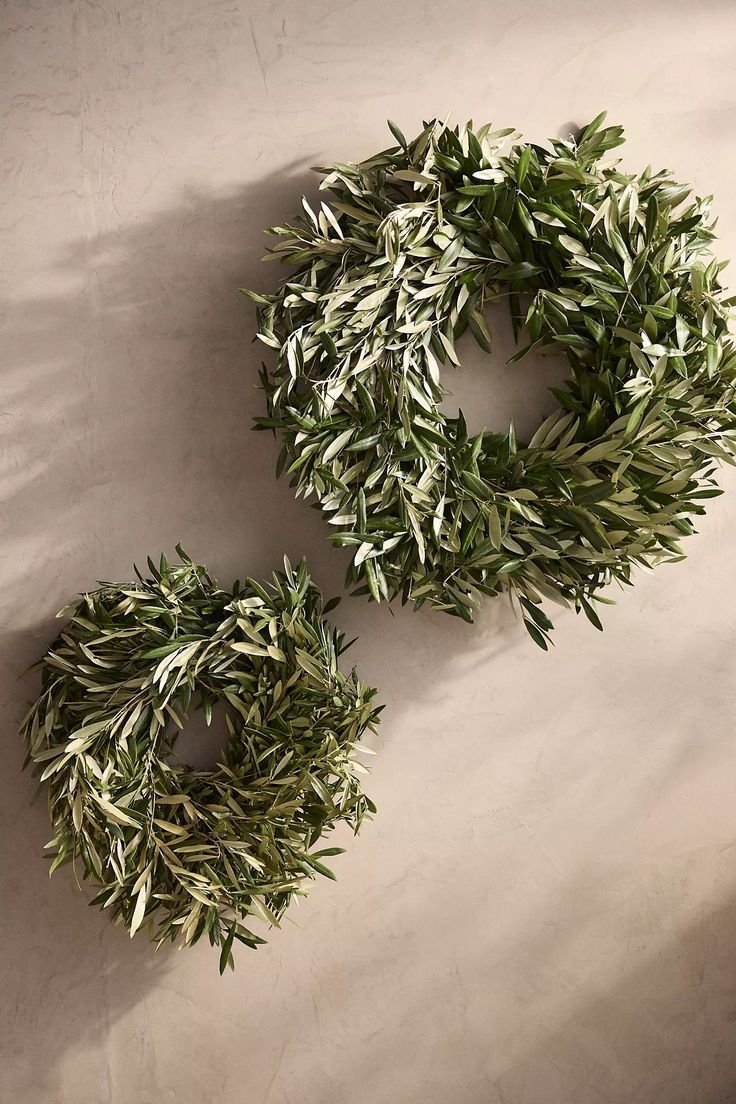
4. Olive branch wreath
Olive foliage offers a solution for anyone whose door calls for something finer and more restrained than a dense green wreath. The muted gray-green and delicate leaf structure create understated Mediterranean elegance that functions in every season.
5. Bay leaf wreath
Bay solves the durability problem that fresh botanical wreaths create. Dried bay holds its form and deepens in color over time — a wreath that genuinely improves with age rather than declining.
6. Magnolia leaf wreath
Magnolia addresses the need for something with genuine visual presence — bold enough to register from the street, refined enough to hold up on close inspection. The two-tone leaf technique adds complexity without requiring additional materials.
Minimalist Solutions for the Detail-Oriented Home
7. Single hoop wreath with asymmetric greenery
This design solves the problem of a wreath that feels too heavy or too “decorated” for a contemporary entrance. The deliberate restraint — metal hoop, single foliage cluster, nothing more — reads as intentional and sophisticated.
8. Dried grass wreath
For homes with warm neutral or natural material exteriors, a dried grass wreath solves the coordination problem that more colorful options create. The warm beige tones sit harmoniously against stone, wood, and natural render.
9. Grapevine wreath, unadorned
An unadorned grapevine wreath is the solution for anyone who wants to avoid the decision entirely. There’s nothing to choose — no color, no added material, no potential for the design to feel wrong in a particular month. Just organic warmth.
10. Wire frame geometric wreath
For entrances with strong architectural geometry, a wire frame wreath solves the visual clash that organic forms can create. The geometric language matches the building; the botanical elements soften it. Balance achieved.
11. Embroidery hoop wreath with pressed flowers
Small-scale and gentle, this design solves the problem of interior spaces that need a botanical element without the scale of a standard wreath. An entryway shelf, a mantle, or a hallway wall — it works in all of them.
Texture-Forward Wreaths That Justify a Long Look
12. Cotton boll wreath
Cotton bolls solve the color palette problem that purely green wreaths create for certain door colors. The white and natural tones are the most neutral option available — coordinating with every exterior without competing with any of them.
13. Dried lavender wreath
Lavender solves the sensory dimension that most wreaths leave unaddressed. The gentle fragrance changes the experience of approaching your door in a way that visual elements alone cannot achieve. Calming in every season.
14. Lamb’s ear wreath
For anyone seeking a texture that reads as soft and gentle rather than bold or graphic, lamb’s ear is the answer. The velvet surface and silvery sage color add warmth without seasonality.
15. Pinecone wreath with a twist
The key insight: pinecones are visually interesting objects. Their seasonal association is a learned convention, not an inherent property. Strip away the convention — no ribbon, no glitter, bleached or pale — and what remains is pure sculptural quality.
16. Moss wreath
Moss solves the problem of a door that needs visual grounding. The deep, saturated green is heavier than other botanical options in the best possible way — solid and anchoring without being heavy-handed.
17. Seashell wreath
A shell wreath done with discipline — whites, creams, pale stone — solves the coastal-decor problem. It reads as refined rather than themed. The material quality speaks; the souvenir-shop association is absent.
Florals That Solve the Freshness Problem
18. Dried hydrangea wreath
Dried hydrangeas solve the maintenance problem that fresh flower wreaths create. They require no water, no replacement, and they reward patience — the color shift from blue to mauve to parchment unfolds slowly and beautifully over months.
19. Peony and rose preserved wreath
Preserved peonies and roses solve the appearance vs. reality problem. They look fresh indefinitely but require no maintenance at all. The quality of modern preservation means this distinction is invisible to visitors.
20. Wildflower meadow wreath
The wildflower wreath solves the problem of forced order. Unlike tightly composed designs, this works through organic looseness — yarrow, statice, strawflowers, and globe amaranth arranged with the same spontaneity as a meadow.
21. Sunflower and wheat wreath
Dried sunflowers and wheat solve the warm-season problem for anyone who loves that golden summer palette but needs it to extend through the year. Dried, the colors hold and deepen, remaining beautiful from summer through winter.
22. White floral wreath
An all-white floral wreath is the color-coordination solution that works without trying. White offends no palette, competes with no door color, and reads as fresh regardless of the season outside.
Natural Material Wreaths That Bring the Outside In
23. Driftwood wreath
Driftwood solves the art-vs-decoration problem. Assembled into a circular form, sun-bleached wood pieces create something that functions as sculpture. The visual interest is intrinsic, not symbolic, which makes it permanently relevant.
24. Birch bark wreath
Birch bark solves the need for a natural material with graphic impact. The black and white patterning creates inherent visual interest that requires no additional elements to be effective.
25. Cinnamon stick wreath
Cinnamon solves the dual problem of visual appeal and sensory experience. The warm amber-brown tones are naturally neutral; the fragrance is gentle and pleasant at any time of year.
26. Wooden bead wreath
Wooden beads solve the scale and weight problem that many botanical wreaths create for sheltered indoor spaces. Lighter visually, warmer materially, and completely adaptable to both indoor and outdoor placement.
27. Cork wreath
Cork solves the sustainability question for the environmentally-minded decorator. Repurposed material, warm tones, interesting texture — all the visual benefits of a quality wreath, with the added value of material reuse.
Impact-Driven Choices That Change the Whole Entrance
28. Oversized wreath (30+ inches)
Scale solves proportion problems that nothing else can. A front door that feels too large or too imposing is immediately balanced by an oversized wreath. The visual result is commanding and welcoming simultaneously.
29. Double wreath
For entrances that feel tall or vertical, two wreaths hung in sequence solve the compositional problem by introducing a designed element that occupies and activates the vertical space. Unexpected and elegant.
30. Asymmetrical wreath
The asymmetrical wreath solves the problem of the entrance that looks too resolved — too expected, too predictable. An off-center or crescent form introduces controlled dynamism that makes visitors look twice.
31. Wreath with trailing ribbons
Trailing ribbons solve the problem of a wreath that disappears against a busy door surface. The vertical element extends the composition downward and creates visual presence that a standard wreath cannot achieve alone.
32. Monogram wreath
The monogram wreath solves the seasonal obsolescence problem completely and permanently. A letterform representing your household will always be appropriate on your door. The calendar is irrelevant.
Interior Wreath Solutions for Every Room
33. Mirror-framing wreath
A wreath around a mirror solves the problem of a hallway that feels flat or uninspiring. The layered composition — organic ring, reflective surface — creates visual depth and immediate interest that neither element generates alone.
34. Candle-surrounding wreath (table centerpiece)
A wreath repurposed as a table centerpiece solves the “too nice for everyday” problem. A wreath that lives on your dining table in January works just as well in December with different candles. It earns its place year-round.
35. Kitchen herb wreath
The herb wreath solves the decorative-vs-functional tension. It looks beautiful on the wall and provides a working herb supply at the same time. No object in a well-designed kitchen should serve only one purpose.
36. Fabric scrap wreath
A fabric wreath solves the problem of textile-heavy interiors that need botanical-adjacent softness without adding a competing natural material. Linen or cotton strips create organic warmth through material rather than botany.
Unconventional Materials, Solved Problems
37. Book page wreath
A book page wreath solves the problem of a home office or reading room that wants a personal, literary element. The material carries meaning beyond the visual — which is a design advantage that purely decorative materials cannot offer.
38. Succulent wreath
A living succulent wreath solves the static display problem. Because the plants continue growing and changing, this wreath is never in the same state twice. The seasonality question becomes moot when the piece is perpetually evolving.
39. Feather wreath
Natural feathers solve the uniqueness problem. Because no two assemblages of feathers are identical, this is one of the only wreaths on this list that is genuinely one of a kind. The organic variation is the feature.
40. Felt ball wreath
Felt balls in an earthy palette solve the playful-vs-sophisticated problem. They have the visual warmth of craft without the seasonal associations — appropriate in a nursery and in a living room with equal confidence.
41. Metal leaf wreath
A metal leaf wreath solves the permanence problem that all botanical wreaths face. Hammered brass or copper doesn’t dry out, fade, or shed. The light-reactive quality of the metallic surface keeps it visually active indefinitely.
42. Rope or jute wreath
A rope wreath solves the problem for entrances that botanical options make feel too delicate or too detailed. The substantial texture and warm neutral tone of natural jute or sisal create presence without decoration.
The Solution Summary
Forty-two designs. One underlying answer to the same problem.
The problem: most wreaths stop working when the season changes.
The solution: choose materials and compositions that don’t depend on seasonal context for their visual quality.
Natural materials. Neutral tones. Timeless design.
Apply these three principles and your wreath works in January as well as it works in October. The bare door problem is solved. Permanently.
Act on It
The right wreath for your home is the one that made you pause.
You recognized it when you saw it. The design that made you think about your front door specifically, not doors in general.
That recognition is the answer.
Follow it. Hang the wreath. And solve the front door problem once, rather than revisiting it every season for the rest of your life.
Your entrance should feel like home every day you arrive at it.
Not just in October. Not just at Christmas.
Every single day of the year. That’s what the right wreath does. And now you know which one to choose.