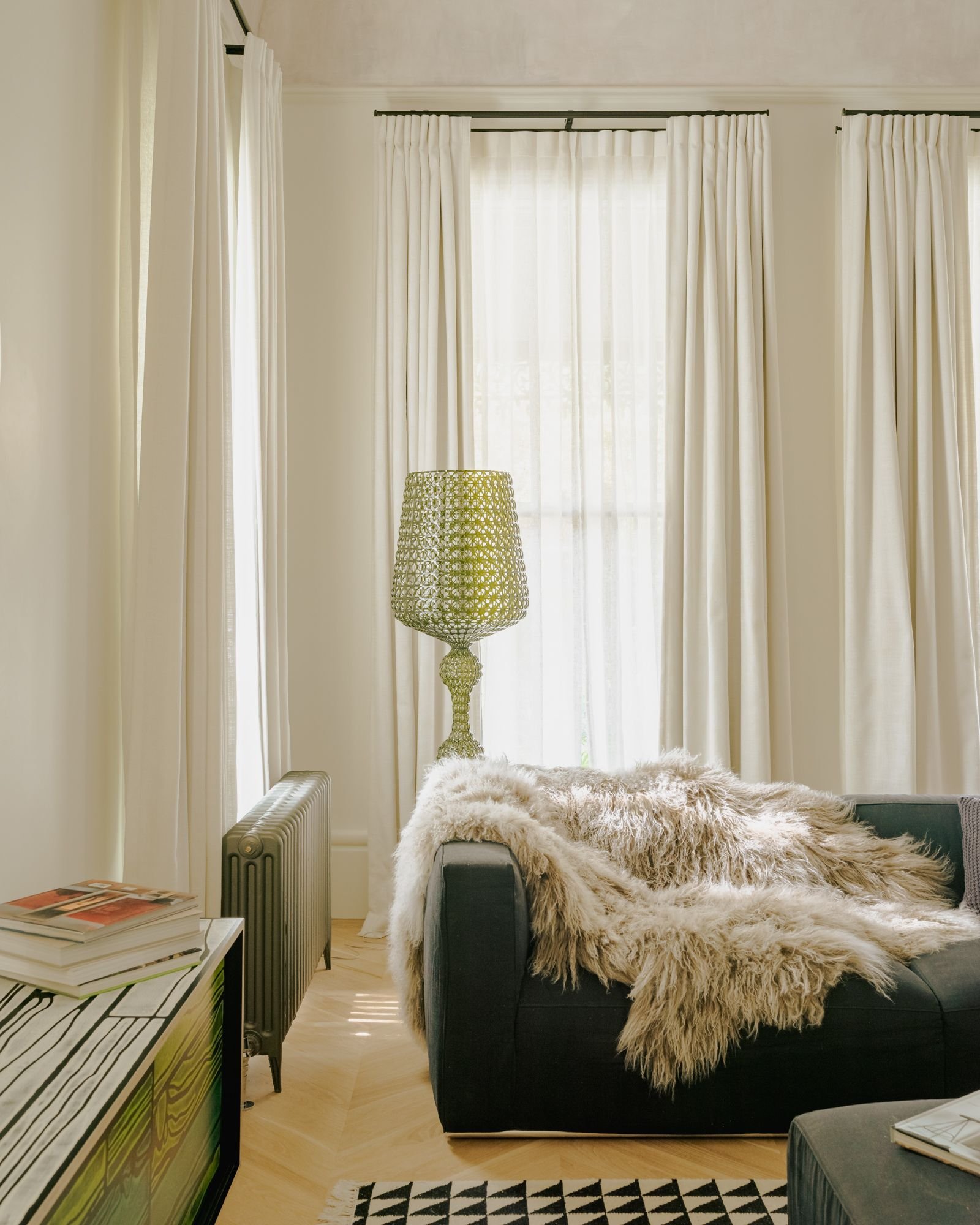
Empty Corner? Here Are 07 Floor Lamp Designs That Will Finally Fix It
Disclosure : This post may contain affiliate links or paid partnerships. I may earn compensation if you click a link or make a purchase, at no additional cost to you. See my disclosure for more info.
Every home has at least one problem corner.
You know what I mean — that empty, awkward space that makes an otherwise well-designed room feel slightly unfinished. No matter what you put there, it never quite works. A plant. A basket. Nothing. You’ve tried, and you’ve given up more than once.
Here’s what actually works: the right floor lamp.
Not just any floor lamp pulled at random from a product page — that can make things worse. But one chosen deliberately for the specific character and dimensions of your corner.
A good floor lamp adds the three things a bare corner is always missing: vertical height, warm light, and the visual sense that someone thought about this space. And unlike most decor decisions, it’s completely reversible if you change your mind.
No more throw pillows as a distraction. Here are seven floor lamp styles that actually solve the problem, and how to figure out which one belongs in your corner.
First: Why Your Empty Corner Is Ruining the Rest of the Room
You made good decisions about your room. A rug you love. Furniture positioned thoughtfully. Maybe a carefully curated wall arrangement.
But the corner got skipped — and it’s quietly undermining all of that effort.
Interior designers know something most homeowners discover slowly: corners frame the entire room. When they’re resolved, everything in the room looks more intentional. When they’re bare, the whole space reads as a work in progress, regardless of what else you’ve done.
Your eye sweeps the room and stumbles at that bare corner. That low-grade sense of “something’s not quite right” that you feel in the space? It starts there.
A floor lamp solves it in one decision. It adds height, warmth, and visual completion — all the things a corner is missing.
The Mistake That Makes Corner Lighting Fail
People buy a lamp they like instead of a lamp that fits their corner.
A lamp that looks incredible in a bright, airy, Scandinavian space may look completely wrong in a warm, richly layered room with darker furniture. Good lamps in the wrong context still look wrong.
The other common problem is scale. Too small beside a large sofa and the lamp disappears. Too large beside a petite chair and it overwhelms everything around it.
The rule: shop for your corner, not for a lamp in the abstract. Read each style below with your actual corner in mind.
1. Arc Floor Lamp — Best for: Behind Sofas, Modern Spaces
The most visually impactful style on this list. An arc floor lamp extends a curved arm outward and casts light from above, like a pendant light without ceiling installation.
Works best: corners behind sofas or beside reading areas; low-profile, streamlined furniture; rooms that can handle a bold focal point.
The key rule: the arc should reach over something purposeful — a side table, a seating area. An arc over empty floor space creates drama with no payoff.
Watch out for: tip-over risk. Verify the base is heavy enough, especially with kids or pets at home.
2. Tripod Floor Lamp — Best for: Versatility, Almost Any Room Style
The most adaptable style in the category. A tripod lamp reads as considered and artistic without competing with its surroundings.
Works best: almost any corner in almost any style room. Wood legs for warm or bohemian rooms; metal legs for industrial or contemporary spaces.
The advantage: doesn’t need a side table or accessories to look complete. It stands on its own.
Placement tip: one leg toward the wall, two toward the room. More stable visually.
3. Torchiere — Best for: Dark Rooms, Spaces Without Ceiling Fixtures
The most room-transforming style when chosen correctly. A torchiere directs light upward, uses the ceiling as a reflective surface, and fills the entire room with soft ambient illumination — not just the corner.
Works best: rooms without overhead fixtures; spaces that feel darker or lower-ceilinged than they should.
Bonus: many modern torchieres feature dimmable LED settings for full atmosphere control.
The catch: ceiling color matters. Works beautifully with white or light ceilings. Dark ceilings absorb the light instead of reflecting it.
4. Pharmacy Floor Lamp — Best for: Reading Corners, Focused Work Areas
The most functional style in the list. A pharmacy lamp has an articulating arm and adjustable shade that directs light exactly where you point it.
Works best: corners beside reading chairs, home offices, creative workspaces. Any corner defined by a specific activity.
The advantage: slim footprint, purposeful look, directional light without flooding the whole room.
Style tip: give it context — a side table, a book, a project nearby. Its purposeful design reads best when there’s an obvious purpose next to it.
5. Statement Sculptural Lamp — Best for: Rooms With Strong Visual Identity
This style is about presence over light output. A sculptural lamp is an art object that happens to glow — chosen because the form itself is worth looking at.
Works best: rooms with a strong, established aesthetic that can anchor a bold piece; corners that need visual impact rather than functional light.
The rule: bold in one dimension only — the form, the material, or the color. Attempting all three produces confusion, not character.
The reward: guests ask where you found it. Every time.
6. Shelf Floor Lamp — Best for: Small Spaces, Corners That Need Both Light and Storage
Two problems, one solution. A shelf floor lamp integrates display shelves into the lamp column, giving you light and display space in a single narrow footprint.
Works best: compact apartments and smaller rooms where floor space is limited; corners that could use display space as much as light.
Display ideas: books, a small succulent, a framed photo.
The non-negotiable rule: leave at least one shelf empty. Full shelves read as clutter; selective shelves read as curation.
7. Rattan or Woven Floor Lamp — Best for: Natural Material Rooms, Atmospheric Spaces
The best choice when atmosphere matters more than task light. A rattan or woven floor lamp casts warm, dappled light through the weave — soft, textured, and impossible to replicate with any smooth shade material.
Works best: rooms with natural materials (wood, linen, ceramics); bedrooms and sunrooms; any space where mood lighting is the priority.
Honest limitation: not a task lamp. Diffused light is excellent for atmosphere and insufficient for focused work. Know which you need.
Corner combo: pair with a floor cushion and a wicker basket for an instantly inviting corner.
How to Choose: Four Questions That Narrow It Down Fast
Question 1: What does this corner need to do?
Task light for reading or focused work → pharmacy lamp. Ambient room brightness → torchiere. Visual presence → tripod, arc, or sculptural. Both light and display → shelf lamp. Pure atmosphere → rattan.
Question 2: What is the ceiling height?
Tall ceiling → arc lamp and torchiere both work well. Standard or low ceiling → pharmacy lamp or moderate-height tripod is safer.
Question 3: What is the room’s existing style?
The lamp’s material and silhouette should feel native to the room — or deliberately, confidently different. Accidental mismatches always read as mistakes.
Question 4: How much floor space is there?
Measure the corner before you shop. Arc lamps and tripods need clearance. Pharmacy lamps and shelf lamps fit narrower footprints.
The One Technique That Makes Any Floor Lamp Look Designer
This costs nothing and makes an immediate visual difference.
Layer your lighting at three heights.
Floor lamp high → table lamp mid → candles low. One light source is an addition. Three light sources at different heights is a scheme — and a scheme is what makes rooms look designed rather than furnished.
Your corner lamp is the anchor of the whole composition. Give it companions and the room transforms.
Make the Decision. Fix the Corner.
You have everything you need to make a good decision.
Match the style to your corner’s function, the lamp’s scale to the furniture around it, and the material to the room’s existing language.
Then buy the lamp. Place it. And see what happens to the room you’ve been living with for months or years.
Because the right floor lamp doesn’t just solve a corner problem.
It finishes a room.
That feeling of something being off? Gone. Replaced by a room that finally looks and feels like what you always wanted it to be.
Go fix the corner.