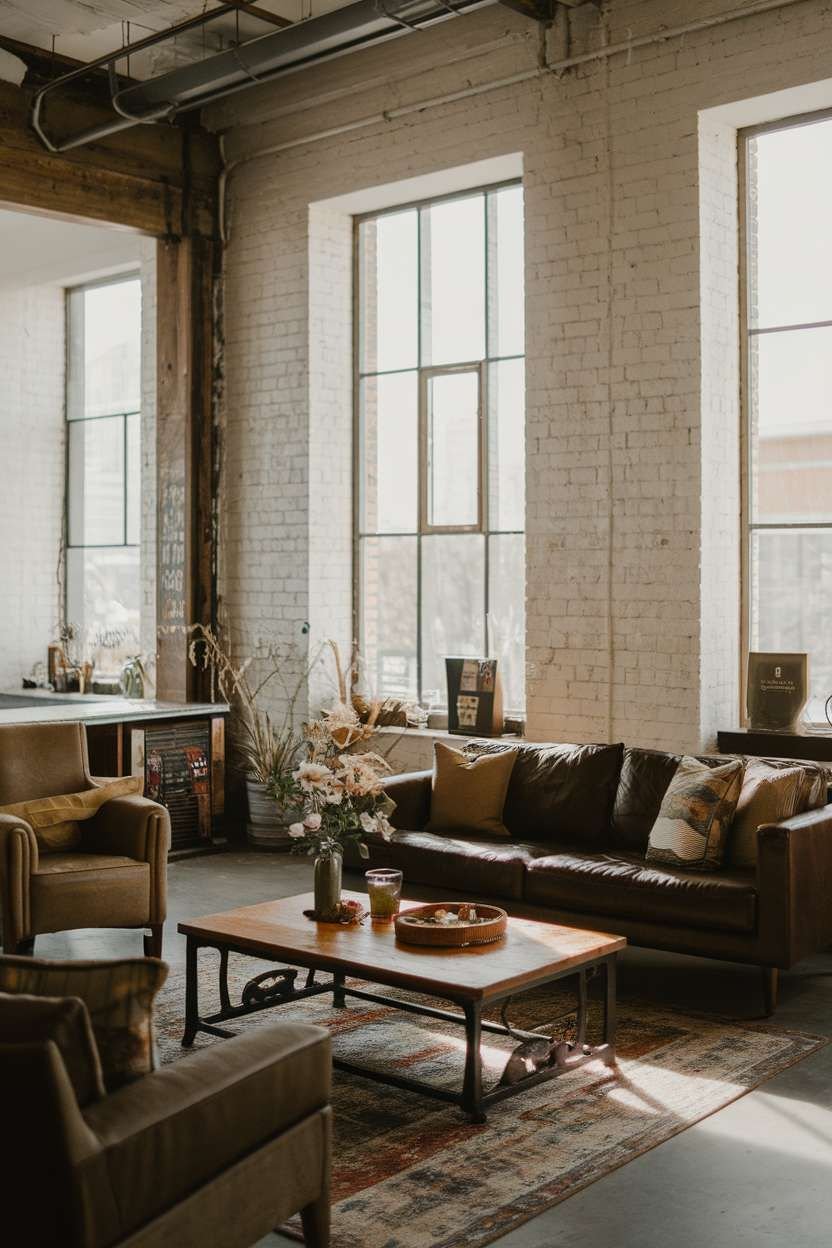
Metal, Wood & Memory – 39 Industrial Living Room Ideas That Stay With You
Disclosure : This post may contain affiliate links or paid partnerships. I may earn compensation if you click a link or make a purchase, at no additional cost to you. See my disclosure for more info.
Your living room has been off and you can’t quite put your finger on why.
It’s not catastrophically wrong. Just quietly not right. A persistent sense that the room doesn’t yet match the one you’ve been picturing in the back of your mind.
Industrial design surfaced somewhere in your research. Exposed steel, reclaimed timber, aged concrete, raw metal pendant fixtures. Something about the unapologetic material honesty of it feels like the right direction.
Then you look at real examples and the warmth question surfaces. Those rooms look like they belong in a lifestyle magazine. Architecturally considered. Humanly absent.
“The aesthetic is everything I want. But I can’t imagine actually living in it.”
Here’s what the best industrial rooms have in common: warmth was engineered into them from the beginning. Not added as a corrective afterthought but woven into the same decisions that produced the raw, honest character. Softness treated as a structural layer alongside metal and concrete.
You don’t have to choose between the look and the livability. These 39 ideas walk you through getting both.
Light Sources That Build Atmosphere Through Layering
The single-pendant industrial room is a cliché because it doesn’t work. One source creates one mood — flat, theatrical, and unchanging through the day.
Atmospheric lighting requires layers: multiple sources, operating at different levels and intensities.
1. Arrange a group of pendant fixtures at staggered heights over the sitting area.
A cluster of three to five pendants at different drop distances creates overhead rhythm and removes the flat quality of a single centered fixture.
2. Station a matte black articulating floor lamp near the reading area.
Posable task lamps are functional first and architecturally present second. Both qualities give them genuine value in an industrial room.
3. Fit warm brass or aged gold wall sconces flanking the sofa or a large artwork.
Brass is industrial design’s warmth accelerant. Two sconces in aged brass soften the room’s metal palette immediately and elegantly.
4. String genuine filament bulbs across the ceiling on heavy black cable.
Real filament. Proper wire. Intentional spacing. Against a high ceiling this is one of the most visually rewarding and cost-effective lighting moves in industrial design.
5. Place a grouping of thick pillar candles on a metal tray as an ambient source.
Open flame cannot be electronically replicated. Candles on a flat tray shift a room’s emotional register in a way that no fixture in any lighting catalog can match.
Plants and Natural Materials — The Biological Counterweight
The fastest corrective for an industrial room that runs sterile?
Put something organic in it.
Living plants, dried botanicals, stone — these materials interrupt the manufactured hardness of the room and introduce warmth that no engineered object can replicate.
6. Position a large-scale plant in an empty vertical corner.
A tall monstera, bird of paradise, or fiddle leaf in a textured basket fills dead vertical space and brings biological warmth into the room at scale.
7. Collect small plants on a metal wall bracket shelf.
Four or five species in varied containers at different heights. A living installation that animates an otherwise bare wall and contrasts beautifully with industrial metal.
8. Arrange dried botanicals in a handthrown stoneware vessel.
Pampas grass, dried cotton, preserved leaves. All the organic texture and silhouette without the maintenance demands of living plants.
9. Use stone objects — a marble tray, a geode as a bookend — throughout the room.
Stone grounds the material palette with natural weight and calm. It belongs naturally alongside iron and reclaimed timber without competing for attention.
Building the Right Structural Foundation
Architecture is the premise that every decorative decision responds to. The structural choices establish the room’s fundamental identity and set the conditions for everything that follows. Get these right and the rest becomes significantly easier.
10. Expose one wall’s brick while keeping surrounding surfaces soft and light.
One accent brick wall is a complete industrial statement. The surrounding walls in warm white provide the contrast that makes the brick more compelling rather than more oppressive.
11. Seal or polish concrete floors before considering them finished.
The surface treatment is what changes concrete from looking like an oversight to looking like a decision. A quality sealer or polish gives the material presence and intention.
12. Install wide-plank reclaimed timber flooring as the warmer flooring alternative.
Salvaged wood delivers warmth, texture, and narrative at the floor level in a way no other material can match. It grounds an industrial room from the bottom up.
13. Choose oversized black steel-frame window glazing.
Industrial interiors are largely defined by their steel-frame windows. The slim dark profiles maximize light and create a factory-honest architectural line that reads instantly.
14. Show structural ceiling beams and bring in warmth through staining.
Exposed beams communicate industrial character the moment eyes reach the ceiling. A honey, amber, or walnut stain converts their rawness into warmth without sacrificing the inherent honesty of the material.
15. Transform exposed ductwork and pipe runs into features with flat black paint.
Functional mechanical elements become intentional graphic line work with a single coat of matte black. The finish is what decides whether they read as neglect or design.
Furniture That Holds the Balance Between Edge and Ease
Most industrial rooms fail at furniture by going all-in on hard, rivet-detailed, metal-framed pieces.
The result is visually consistent and humanly uncomfortable. Nowhere soft to land. No surface that invites. No reason to stay longer than necessary.
Pair every hard material with something that yields and offers softness in return.
16. Open with a large, deeply cushioned leather sofa in a warm-toned leather.
Cognac or rich brown full-grain leather is the single warmest furniture move available in an industrial room. It improves with age and communicates welcome without trying.
17. Place a live-edge or slab wood coffee table at the center.
Natural wood edges introduce organic movement and life into the geometric rigidity around them. Look for a piece with a genuinely unmanufactured silhouette and real wood character.
18. Add upholstered chairs in a plush or tactile fabric opposite the sofa.
Velvet, boucle, or heavyweight linen across from the leather sofa. The fabric choice does the emotional work — these chairs invite you to sit down, stay, and be at ease.
19. Curate an iron-and-timber open shelving unit with space deliberately left empty.
A plant, a book, one ceramic object per section. Breathing room on open shelves reads as curated confidence. Every shelf packed solid reads as anxiety.
20. Use a leather trunk with visible patina as an accent table near the seating.
Genuine wear. Hidden storage. The sense that the room was assembled slowly by someone with taste rather than decorated in an afternoon.
21. Draw a large woven pouf into the sitting area.
A chunky textured pouf breaks the seriousness of industrial design with one casual, tactile gesture. It signals that ease is welcome here — and means it.
Color Decisions That Prevent the Industrial Room From Running Cold
Industrial is not a gray genre. Treating it as one produces rooms that feel punishing rather than powerful.
“Doesn’t it have to stay mostly dark and neutral?”
No. That’s a misreading of what the style actually asks for.
Color warmth is a core design decision, not an add-on after the hard elements are in place.
22. Select warm white for the walls, not cool gray or blue-leaning neutral.
A slightly warm white handles the room’s varying light conditions gracefully throughout the day. Cool whites and grays harden under lower light and make the space feel clinical.
23. Thread rust, ochre, and terracotta through objects and textiles as recurring accents.
An ochre ceramic bowl. A terracotta-glazed planter. A burnt orange blanket. These tones share their origin with brick and iron and feel entirely native in their company.
24. Bring green through the room in both plant and textile form.
Plants contribute green naturally. An olive or forest-green cushion deepens the green presence. Together they prevent the palette from closing in on itself.
25. Apply matte black as selective punctuation rather than as a general atmosphere.
Frames. Lamp bases. Hardware. A tray. Matte black functions as emphasis and definition — it should never become the room’s default state. Restraint is the rule.
Small Refinements That Reveal a Practiced Hand
What separates a room that impresses from one that merely pleases? These small decisions, made with consistency and care.
Each one is minor. Their combined effect is not.
26. Replace standard switch plates with matte black or brushed brass alternatives.
Fast, inexpensive, immediately effective. One of the few upgrades that yields a result far exceeding its cost in time and money.
27. Display books on open shelves with spines facing inward.
The calm, tonal surface created by exposed paper edges is significantly more composed than the color chaos of facing spines. Quiet but transformative.
28. Arrange a contained vignette on a board placed on the coffee table.
A board as a platform. A candle, a small trailing plant, one object with visual weight. Contained and deliberate, it gives the table surface meaning and focus.
29. Standardize all hardware finishes to one matte family throughout the room.
Matte black, brushed brass, or hammered iron. One, applied consistently. Any polished chrome intrusion fractures the visual logic of industrial design at the detail level.
30. Overlay a vintage or faded rug on a large jute foundation rug.
The jute grounds. The vintage piece contributes color, history, and personal character on top. Layered together, they create a floor treatment richer than either achieves alone.
31. Leave at least one visibly imperfect piece in the room without apology.
A chipped planter, a table with raw saw marks, a chair whose leather shows its age. This is not a flaw. This is industrial style demonstrating its honesty.
Soft Furnishings That Convert Architecture Into a Home
Strip out every soft furnishing from an industrial room.
What remains is structurally correct and humanly empty. Not a home — an uninhabited installation.
Textiles are the material evidence that living actually happens here. Without them, the room fails its most important test.
32. Ground the seating area with a large-format jute or sisal area rug.
Larger than your instinct recommends. Every major piece’s front legs sitting on top of it. A properly scaled natural rug unifies the space and adds warmth at every level.
33. Lay a heavy knit blanket across the back or arm of the sofa.
The simplest, most immediately impactful warmth gesture available. This throw communicates “come in, sit down, stay” before anyone has spoken a word.
34. Combine linen, wool, and cotton cushions in mismatched earthen tones and sizes.
Rust, slate, cream, sage, ochre. Different weave textures, different dimensions. The goal is the appearance of accumulation over time, not coordination in a single shopping session.
35. Hang floor-length linen curtains in a warm natural or oatmeal shade.
Even alongside dramatic industrial windows, full-length linen curtains add a soft layer that the architecture alone cannot supply. Natural linen allowed to fall fully from ceiling to floor is quietly, effortlessly elegant.
Making the Walls Part of the Room’s Story
Brick and concrete walls speak through texture. Bare standard drywall speaks through emptiness — and that’s not a statement.
36. Commit to one large abstract or graphic work in a stripped-back industrial frame.
Go large and commit. One oversized work above the sofa or on the main wall carries far more authority than several smaller pieces combined. A bare metal or raw timber frame maintains visual honesty.
37. Build a multi-piece gallery arrangement using frames in mixed and contrasting materials.
Iron, natural wood, aged brass — varied in scale and format. The visual interest emerges from the mix itself, not any single piece. A gallery wall reads as personal history built over time.
38. Position a large metal-framed wall mirror or an exposed-mechanism clock as a focal wall object.
Large mirrors amplify light and make smaller rooms feel expanded. Exposed-movement clocks operate as functional wall sculpture. Both justify their wall space with multiple forms of value.
39. Rest pieces against the wall on a ledge or shelf rather than hanging everything.
Propped art suggests organic growth. The room evolving with the person who lives in it, not a space installed once and frozen. In industrial design, that’s exactly the right spirit.
This Is the Room You’ve Been Building Toward
The ideas have been accumulating for a while now. Some pieces in place. The direction clear. The complete picture still just ahead.
The reason it hasn’t clicked is that warmth in an industrial room isn’t built by adding things — it’s built by creating the right relationships between things. Soft paired with hard. Warm paired with cool. Organic paired with geometric. Those tensions, held in balance, produce the quality you’ve been after.
You don’t need to implement all 39 ideas. Take the ones that match your room, your life, and your immediate capacity. Start with one. Return to the list when you’re ready for the next.
The moment when the room stops being a project and starts being a home is closer than it probably feels right now.
Choose one idea from this list. Start this week.
Your room has been patient. Now give it what it needs.
🔍 Focus Keyphrase: industrial living room ideas
📌 SEO Title: 39 Industrial Living Room Ideas That Feel Like Home
🔗 Slug: industrial-living-room-ideas
📝 Meta Description: Discover 39 industrial living room ideas that balance raw style with real warmth. From lighting layers to textiles — make the look truly livable.