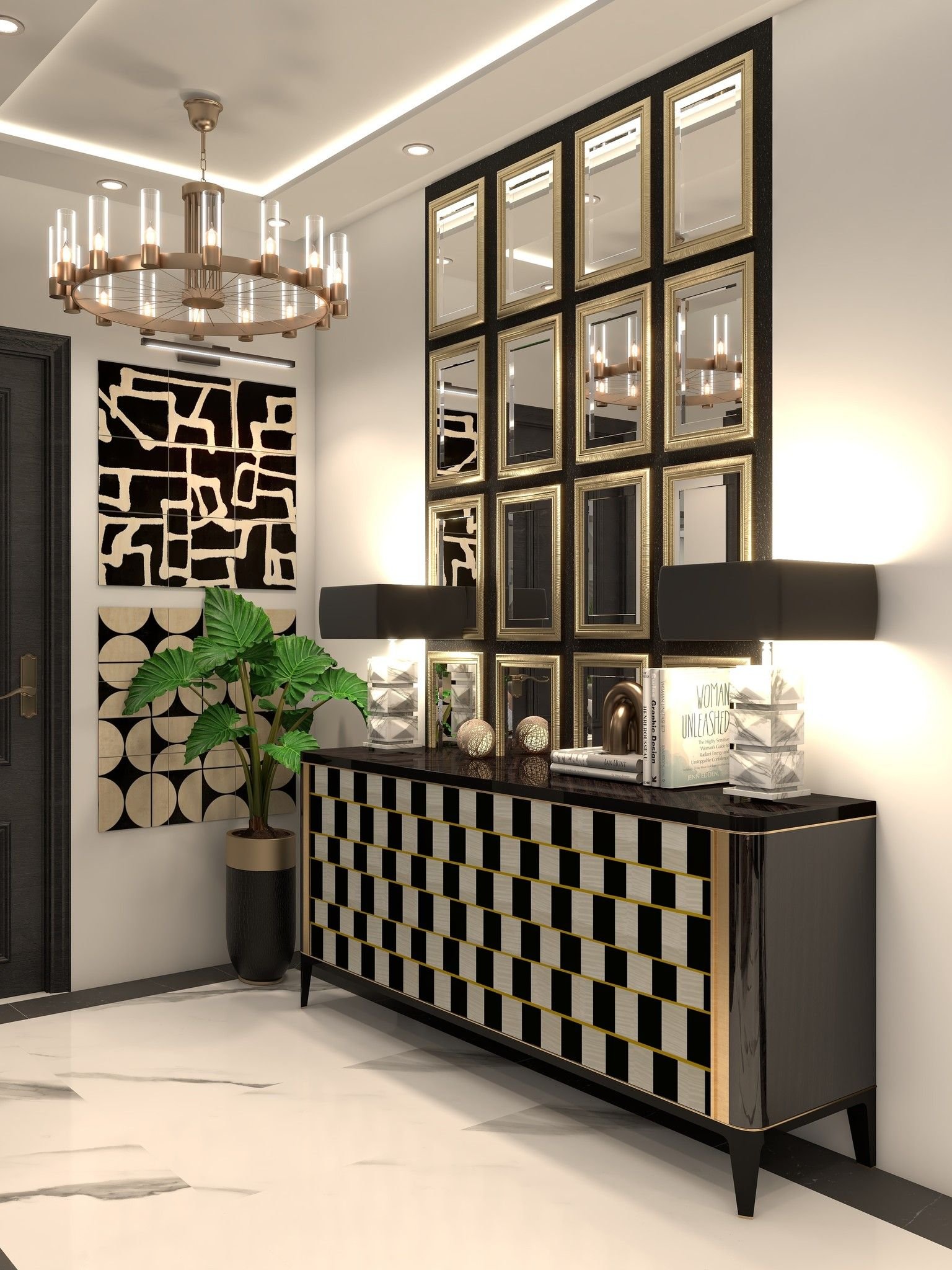
Prestige-Level Console Table Concepts for an Entryway That Wows on Impact
Disclosure : This post may contain affiliate links or paid partnerships. I may earn compensation if you click a link or make a purchase, at no additional cost to you. See my disclosure for more info.
Walk into your own home today as if you’ve never seen it before.
What’s the first thing that registers?
If the answer is “nothing much” — or worse, a wall that’s been waiting for a solution for longer than you’d like to admit — you already know what this guide is about.
You’ve collected reference images. You’ve bookmarked beautiful rooms. You’ve stood in furniture galleries understanding exactly what you want and walking away without it.
Here’s the insight that’s been missing about luxury console tables: the gap between what you have and what you want is not a money gap. It’s a knowledge gap. The visual principles that produce the high-end result are learnable, repeatable, and applicable at almost any budget.
Every single one of them is in this guide.
Whether your entry is a wide, generous foyer or a hallway barely wider than a car, these ideas will give you everything you need to create the impression you’ve been after.
The Console Table’s Hidden Power: Why It Controls Your Home’s Entire First Impression
Stop and think about the sequence of perception when someone enters your home.
The console table is the first piece of furniture anyone visually registers. Before the sofa. Before the art. Before the kitchen that took months of decisions to renovate.
It primes expectation. It announces character. It creates an immediate, wordless impression that everything that follows either confirms or contradicts.
Yet in most homes, this pivotal piece of real estate goes to waste. Random accumulation. Things placed without thought. A surface that communicates nothing at all.
Think of the best opening scenes in film — the ones that tell you in thirty seconds exactly what kind of story you’re about to experience.
Your console table is that scene. Direct it.
1. The Monumental Stone Console That Defines the Room Around It
There is always that one piece in a designer showroom that anchors the entire floor. Walk toward it and you feel the pull before you can articulate why.
Look closely. It is almost always made of stone.
Marble, travertine, concrete — materials that carry geological authority no manufactured surface can approximate. They feel permanent. They feel formed, not fabricated.
A stone console needs nothing to support it. No mirror. No gallery wall. No carefully curated accessories.
It holds the room in place simply by being present.
Prioritize sculptural, non-standard forms: organic curves, asymmetrical silhouettes, edges that look shaped by hand. These are the profiles that define the leading edge of contemporary high-end design.
A Calacatta marble waterfall console with a single ceramic vessel is a complete composition. It needs nothing else. Resist the urge to add.
2. The Transparent Metal-and-Glass Console for Spaces That Can’t Afford Bulk
Many homes have entryways that simply cannot accommodate a generous-sized console without compromising traffic flow. The corridor is too narrow. The space is too tight to navigate comfortably with anything substantial in it.
This isn’t a problem — it’s an invitation to be more precise.
A slim glass-topped brass console solves the spatial equation without sacrificing visual character. The glass top is effectively invisible. The warm brass or gold-toned frame delivers the richness and personality the space needs.
The specification to guide your search: 10 to 12 inches of depth. Wide enough to hold a lamp and a decorative tray. Narrow enough that the hallway remains genuinely usable.
Elegance is always available. It’s a function of precision, not of space.
3. The Fluted Wood Console That Introduces Living, Dynamic Texture
Flat, uninterrupted surfaces are visually static. They don’t engage the eye because there’s nothing to engage with — no variation, no depth, no reason to look twice.
Fluting — the repeated vertical channels carved into the surface — solves this definitively. Each groove creates its own micro-shadow. The entire surface animates throughout the day as light travels across it.
The technique is ancient — borrowed from Greek column design — and it has been revived on contemporary furniture precisely because it does something modern materials cannot: it gives surfaces genuine visual life.
A warm oak fluted console in natural tones. Or bold, hand-carved channels on a mango wood piece. Either choice brings something irreplaceable: texture that rewards attention.
4. The Arched Console That Makes a Modern Entry Feel Timeless
Arched forms have become the defining visual vocabulary of contemporary high-end design. Arched mirrors. Arched beds. Arched doorways. The curve communicates both architectural history and modern confidence in the same breath.
The arched console base brings this to the entry in a way that still feels fresh and unexpected to most visitors.
A single generous arc or a series of smaller arches introduces formal elegance and graceful warmth simultaneously — qualities that straight-legged consoles simply cannot provide.
Hang a rectangular mirror above. The tension between the curve below and the geometric frame above is the compositional engine that makes the whole vignette feel designed rather than assembled.
5. The Levitating Console That Makes the Whole Entry Feel Curated
The quality that most reliably distinguishes a professionally designed interior from one that isn’t: the intentional treatment of space itself. Including — especially — the space below the furniture.
A wall-mounted floating console turns the gap beneath it into a design statement. That space below the table isn’t emptiness — it’s breathing room. It creates the perception of weightlessness that makes the entire composition feel deliberately, professionally considered.
Yes, the floor beneath it stays clean with minimal effort. That’s the least of what this choice achieves.
What it primarily delivers is a room that reads as carefully edited from floor to ceiling.
Choose walnut or matte black. Keep the surface minimal — a candle, one book, one object. Protect the space around it. That’s where the design lives.
6. The Black Console That Makes Every Other Element in the Room Look More Expensive
One principle that works as reliably in interior design as it does in art direction: dark backgrounds make everything placed against them appear richer.
A black console — in lacquered finish, matte black metal, or ebonized wood — creates the visual gravity that organizes the entire entry. Against it, everything else sharpens. Colors become more vivid. Forms become more defined.
Think of how a jeweler displays pieces on black velvet: the contrast makes the work unmissable.
The key nuance, and where most people stumble: don’t style it in matching dark tones.
A white marble tray. A warm brass lamp. A pale ceramic vase. Let the dark foundation make lighter objects luminous by contrast.
7. The Reflective Console That Solves a Structurally Dark Entry
Some entries simply don’t get enough light. Low ceilings compress the room. No exterior windows mean no natural glow. Dark walls absorb rather than reflect what little light exists.
A mirrored or metallic console is the most direct and beautiful solution to this problem. Antiqued mirror finishes add warmth and depth as they reflect. Chrome delivers a cool, crisp contemporary glow. Hammered metal textures the reflection, adding visual complexity while distributing ambient light.
What makes this strategy particularly intelligent: the reflective console is furniture and lighting infrastructure simultaneously. A single purchase that solves two problems at once.
Add a lamp on the surface and the entry transforms — warmth amplified across every metallic plane in the room.
8. The Multi-Function Console That Hides Life’s Daily Disorder
No point dressing this up: entryways collect life. Bags that don’t have a permanent home. Mail that’s been half-read. Keys that were somewhere else entirely five minutes ago.
A console that can’t handle this reality fails the space — no matter how beautiful.
A console with integrated drawers or shelved storage absorbs the daily accumulation completely. The surface remains pristine. The clutter remains invisible.
The requirement: the exterior must be as beautiful as if no storage existed.
Push-open drawers with no visible hardware. Lower shelves styled with woven baskets. The surface reads as effortlessly, perpetually composed. That’s the goal.
9. The Height-and-Depth Styling Method That Makes Any Console Look Professionally Curated
Here’s something most guides sidestep entirely:
Buying the right console is only half the work. Styling the surface correctly is the other half — and it’s the half that determines whether the whole thing succeeds.
The professional framework: three objects at three deliberate heights, arranged in an asymmetric grouping.
- Tall: a lamp, a sculptural vase with height, artwork propped against the wall
- Medium: a stack of considered books, a candle cluster, a sculptural object of consequence
- Low: a tray, a shallow decorative bowl, a flat beautiful object
Group them asymmetrically. Step back. Refine until it reads as natural, not staged.
The principle above all others: preserve empty surface between groupings. A console with breathing room signals confidence. A surface filled edge-to-edge signals the opposite.
10. The Character-Material Console That Gives Your Home a Distinct Voice
For homeowners who want their entry to be genuinely impossible to forget:
Stop browsing the same lists everyone else is browsing. Pass on the default marble and the expected walnut. Find the material that belongs to your specific sensibility.
Rattan and cane bring warmth and a worldly, collected quality that mass-market materials can’t replicate. Shagreen-effect finishes — authentic or faux — deliver exotic, skin-like texture with genuine presence. Resin in a saturated jewel tone — cobalt, emerald, amber — turns the console into the room’s central argument.
Reclaimed timber on welded iron legs carries narrative and craft simultaneously. Poured concrete on blackened steel brings gallery-level authority into a residential setting without apology.
The sole design principle that actually matters: choose a material that expresses your genuine point of view. Everything else is following.
The Two Measurements That Separate Great Console Setups From Almost-Great Ones
One piece of critical guidance before any shopping begins.
Height and proportions are non-negotiable.
A table that sits too low lacks visual authority — it reads as accidental. One that’s too tall loses its domestic character entirely and drifts into commercial territory.
The working range: 28 to 34 inches tall. For most residential entries, 30 inches — the height of a sofa back — is optimal.
The second measurement: how high any mirror or artwork above the console should sit. The answer: lower edge 3 to 6 inches above the table surface. Near enough to feel connected. Far enough to breathe.
Two measurements. The entire difference between a setup that looks expensive and one that looks like it’s almost there.
The Entryway You’ve Been Imagining Is One Decision Away
You have everything now. Every principle. Every idea. Every measurement that matters.
You understand that the right console table isn’t furniture in the ordinary sense — it’s the moment your home introduces itself. It’s the feeling that persists in a guest’s mind long after they’ve left.
Two options remain.
Walk past the wall one more time and tell yourself it’s a project for later. Or choose one idea — just one — and begin building the entry you’ve been carrying in your imagination.
The prestige-level result isn’t protected by price or privilege.
It belongs to anyone who understands what creates it. You do now.
Go make your entrance unforgettable.
“The right console table is not just furniture — it is the opening line of your home’s story.”