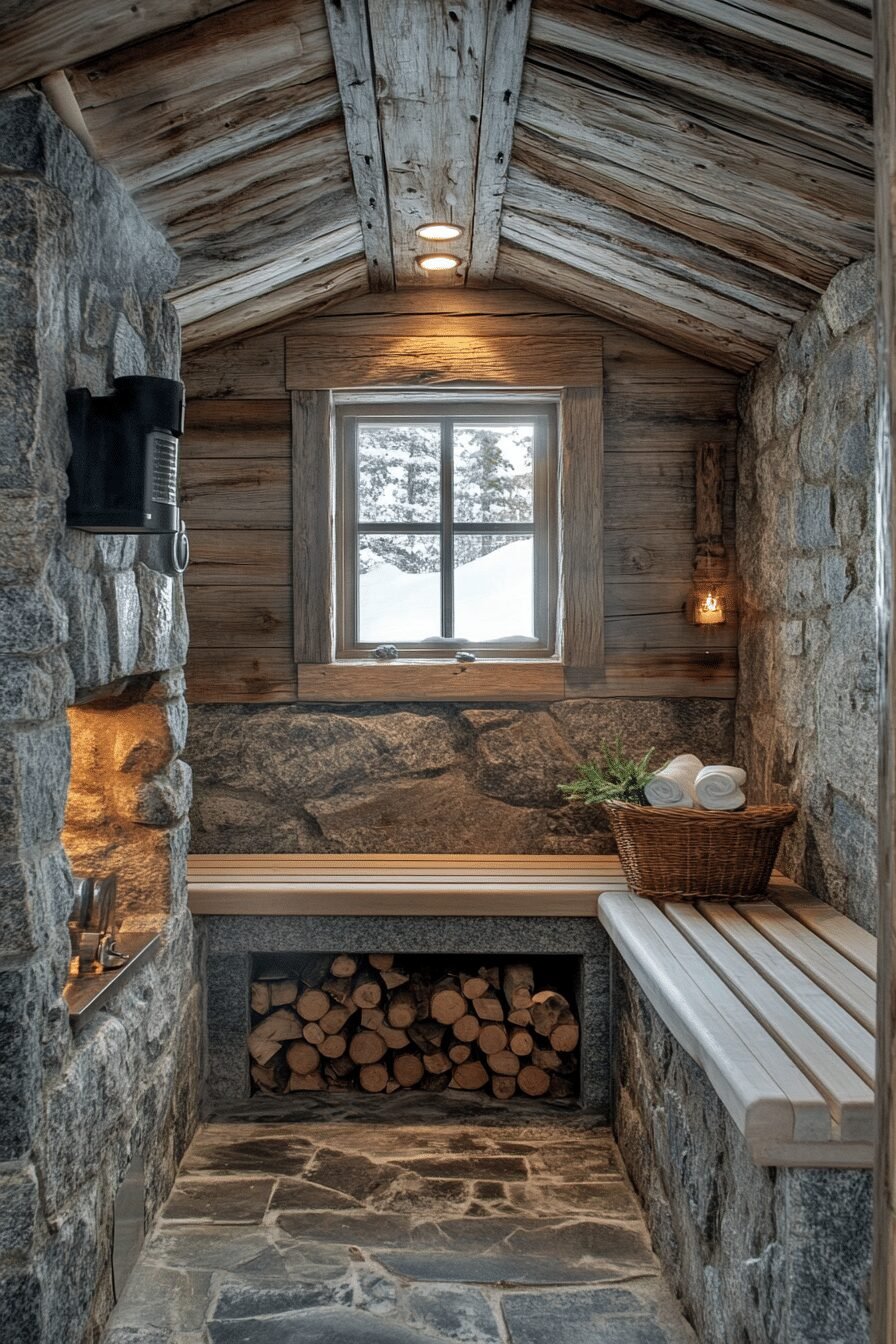
Build Your Own Home Sauna: A Smart Investment in Comfort and Recovery
Disclosure : This post may contain affiliate links or paid partnerships. I may earn compensation if you click a link or make a purchase, at no additional cost to you. See my disclosure for more info.
Consider what you’ve already spent on recovery.
Gym memberships that include sauna access. Day spa bookings. Hotel rates chosen partly because the property has a good one. Add it up over a few years and the number is not trivial. Now consider: a well-built home sauna, constructed yourself, available every day, for decades. The economics change entirely.
The construction is achievable. The savings are real. The daily access is the part that changes how you feel every week. This guide shows you exactly how to do it.
Why the Research Phase Costs Most People the Project Entirely
The information problem is real. Online forums offer a thousand opinions and no clear sequence. People end up comparing finishing accessories before they’ve resolved their heat type. Pricing out a complete setup kit before they’ve measured the space. The confusion isn’t about the work — it’s about not having a decision order. This guide gives you that order. Follow it and the project becomes straightforward.
1. The Location Decision — Your Highest-Leverage Starting Point
Where the sauna lives determines almost everything that follows: materials, electrical routing, drainage, and the daily convenience that makes you actually use it. Evaluate your options honestly before committing. Productive locations: a basement room or existing bathroom with plumbing access, a garage section with proximity to the electrical panel, a detached outdoor structure, or a large closet for a compact 1-person infrared cabin.
Non-negotiable requirements: floor drainage, accessible electrical service, and flooring that tolerates sustained moisture. Tile and concrete are ideal. Rigid vinyl qualifies. Carpet is incompatible with this environment and cannot be made to work. Build the cool-down sequence into your planning — proximity to a shower or exterior door increases how often you use the sauna significantly. Ceiling height: 7 feet maximum. Heat rises. Anything above that threshold is unused volume the heater has to pay for.
2. Traditional vs. Infrared — Choosing the Experience That Matches Your Goals
This is the decision with the widest downstream impact. Make it deliberately and everything else becomes easier to plan. Traditional Finnish sauna: A high-output stone heater drives the room to 150°F–195°F. Water on the stones produces the steam that defines the Finnish experience. Higher construction investment — 240V wiring, more robust insulation — but the performance delivers on every promise.
Infrared sauna: Radiant panels heat the body directly. Operating range is 120°F–150°F. Lower energy consumption and a substantially simpler installation path. A high-quality 2-person cedar infrared sauna runs on a standard household circuit. This choice determines your wood list, electrical load, insulation spec, and ventilation design. Settle it before you buy anything.
3. Room Dimensions — Build for Performance, Not Impression
The instinct to build large works against you here. An oversized sauna heats slowly, taxes the heater, and costs more per session to operate without delivering a better experience. Optimal sizing by use: single user — 3’ x 3’ infrared or 4’ x 4’ traditional, or a compact 2-person traditional steam sauna; two users — 4’ x 6’; family use — 5’ x 7’, where a 4-person cedar indoor sauna delivers excellent value at scale.
Match heater kilowattage to your room’s cubic footage using the manufacturer’s published spec. An undersized heater runs continuously without reaching temperature — wasted energy. An oversized one creates a safety hazard. The calculation takes ten minutes and protects your entire investment.
4. Wood Selection — Where Material Quality Becomes Daily Comfort
The wood in your sauna is the surface your body interacts with every session. Quality here is not cosmetic — it is functional. Western red cedar is the benchmark: naturally moisture-resistant, thermally stable, aromatic, and comfortable against skin even at elevated temperatures. It is the industry standard for good reason.
Viable alternatives that protect your investment: Hemlock — the budget-conscious option with a neutral scent, available as tongue-and-groove boards; Basswood — top recommendation for fragrance-sensitive users; Nordic spruce — the performance standard in European commercial saunas. What destroys the investment: Pine sap bleeds at operating temperature, creating a sticky and unpleasant surface. Oak retains heat to the point of causing burns. Pressure-treated lumber releases toxic compounds when heated — a genuine health hazard that invalidates any cost saving. Install tongue-and-groove paneling horizontally, ¾” to 1” thick. Round every bench edge before installation.
5. Structural Insulation — The Investment That Pays Every Session
Insulation is where a well-planned sauna separates itself from one that consistently underperforms. Under-insulate and you’re paying to heat the room twice: once to compensate for what’s escaping, once to reach an actual usable temperature. Framing: 2×4 stud construction, 16 inches on center. Insulation targets: R-13 in walls, R-22 minimum in the ceiling. The ceiling is the highest-priority surface because heat exits upward fastest.
Vapor barrier: The most commonly skipped step and the one with the most expensive long-term consequences when omitted. Install aluminum foil barrier on the interior-facing side of the insulation. It reflects radiant heat back into the room and prevents moisture from penetrating the wall assembly and degrading the framing. Plastic film and standard housewrap are not substitutes. Use foil tape on every seam and overlap generously. A single gap is an entry point for moisture that silently destroys the structure from the inside out.
6. Ventilation — Protecting Both the Structure and the People Inside It
Inadequate ventilation has two consequences: it makes the sauna dangerous to use and it destroys the structure over time. Two correctly positioned vents prevent both. Low intake vent: near the heater, approximately 6 inches from the floor. High exhaust vent: near the ceiling on the opposite wall, with an adjustable damper. Natural convection drives the cycle: cool air enters at floor level, heats as it rises, and pushes stale air out through the top.
The openings are small — approximately 4” x 6” each. Their protective value is proportionally large. Without them, CO₂ builds to hazardous levels during sessions. Between sessions, trapped humidity prevents the wood from drying, which is how mold takes hold inside a sealed sauna structure. Either outcome damages the investment significantly. Two vents, correctly positioned, prevent both.
7. The Heater — Choosing the Right Power Plant for Your Room
The heater is the highest-cost single component and the one where a sizing mistake is most visible. Get it right and the room performs exactly as designed. Traditional electric heaters: Select a unit with reliable panel controls and match kilowattage to room cubic footage precisely. These units operate on a dedicated 240V circuit at 30 to 60 amps. The Harvia 6kW KIP is a widely used reference for capacity planning discussions with your electrician.
A licensed electrician must complete all 240V wiring. This is both a legal requirement and a fire-safety essential. Infrared heaters: Most run on standard 120V. No dedicated circuit required in most cases. A quality 2-person far infrared cedar sauna installs like a standard appliance. For buyers weighing simplicity and lower upfront installation cost, infrared delivers strong value.
8. Door Specification — Safety and Longevity in Two Simple Rules
The door must be solid and must open outward. These requirements are safety-driven, not aesthetic. Solid construction resists warping under sustained heat. Outward swing ensures emergency access remains possible if an occupant loses consciousness — an inward-opening door blocked by a person on the floor can be catastrophic.
Tempered glass doors are the most popular choice: they maintain the investment value of the room by keeping it feeling open and well-lit without compromising on safety. Solid wood with a glass inset works equally well. Hardware: magnetic catch or spring latch only. A lock on a sauna door is a non-negotiable safety violation.
9. Lighting — The Fixture Specification That Protects the Installation
Standard residential fixtures are not built for sauna conditions. Sustained heat above 150°F combined with periodic humidity cycling will cause them to fail. The failure mode can be hazardous. Vapor-proof, heat-rated fixtures are specified for exactly this environment and will perform for the life of the sauna. Sauna-rated LED strip lighting is equally valid and produces excellent low-level ambient light.
Mount fixtures below the seated sight line or recessed behind bench structures. Overhead lighting in a sauna is counterproductive to the purpose of the room. A compatible dimmer switch is a minor addition that delivers a meaningful upgrade in atmosphere, allowing the room to shift from energizing to deeply restorative without any structural change.
10. The Accessory Layer — Completing the Return on Your Build
Bench system: An L-shaped configuration maximizes usable surface in any footprint. The upper bench delivers maximum heat intensity; the lower provides a moderate option and functions as a footrest. A quality cedar sauna bench properly sized to your room is the daily-use surface that defines the experience — material quality directly affects comfort. Backrest: A simple angled support cut from bench material, or a pre-finished wooden sauna backrest for immediate installation.
Steam tools: A wooden bucket and ladle for traditional saunas — the mechanism for producing löyly, the defining feature of the Finnish experience. Session instruments: A wall-mounted thermometer and hygrometer at seated head height for real-time condition monitoring; a sand timer for session tracking without technology. Floor finish: Hard moisture-tolerant flooring as the base layer, with a removable slatted wood mat on top for comfort and drainage. Lifts out for drying and cleaning.
11. Curing — Protecting the Wood Investment Before First Use
New construction lumber holds residual moisture. Curing drives it out and stabilizes the wood’s natural resins before the first real session. Run the heater to 140°F and maintain that temperature for one to two hours, opening the door a few times throughout. Repeat the process two to three times over consecutive days.
A strong wood aroma during curing — particularly with cedar — is normal and expected. It diminishes rapidly with subsequent uses. After the curing cycles are complete, run your first real session. Add water to the sauna stones if you built a traditional sauna. The investment is now fully operational and ready to deliver returns every time you use it.
A Finite Project. An Indefinite Return.
The math is straightforward. A home sauna built correctly, using quality materials and sound construction practices, will perform reliably for twenty or more years. Every session is a return on the original investment. Every morning you use it instead of driving to a gym is a compounding dividend.
The construction takes a few weekends. The planning takes less time than you’ve already spent thinking about it. The return is daily, immediate, and long-lasting. Begin with the location decision. Everything else follows from that single choice. The time to start is now.
🔍 Focus Keyphrase: home sauna DIY
📌 SEO Title: Home Sauna DIY: Build One Yourself — Complete Guide
🔗 Slug: home-sauna-diy-build-one-yourself
📝 Meta Description: Build a home sauna that pays for itself in comfort and savings. A complete guide covering location, materials, heater selection, insulation, and every finishing detail.