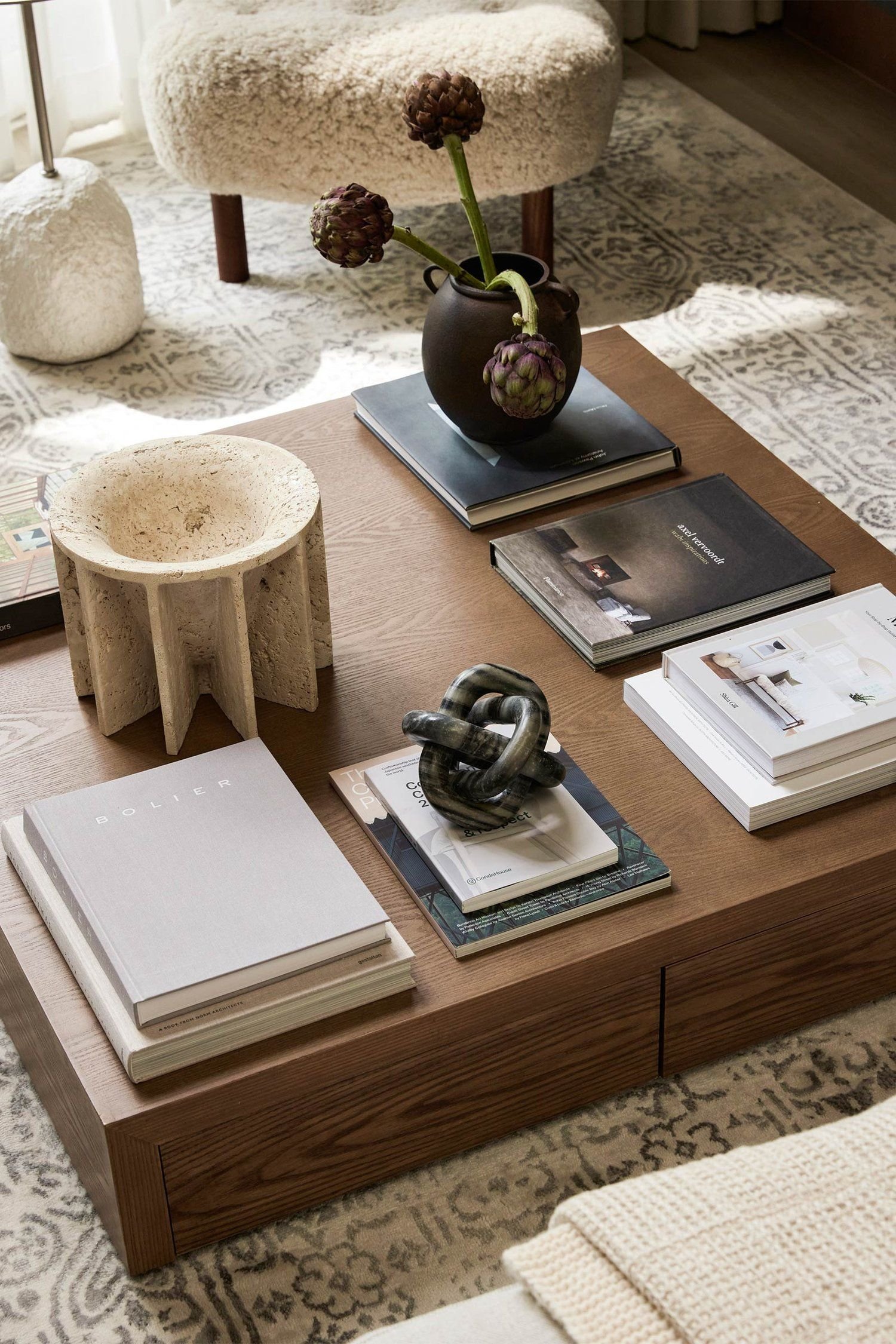
29 Elegant Coffee Table Designs That Give Your Living Room Instant Character
Disclosure : This post may contain affiliate links or paid partnerships. I may earn compensation if you click a link or make a purchase, at no additional cost to you. See my disclosure for more info.
Your living room has good bones.
You know it. The space is there. The layout works. The proportions are fine.
But something is keeping it from feeling the way you want it to feel. Some invisible barrier between functional and genuinely impressive.
Most likely, that barrier is 18 inches off the ground. Right in the center of your seating area.
It’s the coffee table. The one that’s been there so long you stopped seeing it. The one that technically serves its purpose while contributing absolutely nothing else.
The coffee table is not just a surface. It’s the room’s character piece.
In every well-designed living room, the center table does three things simultaneously: it anchors the seating arrangement spatially, it establishes the room’s material palette, and it creates the focal point that the eye returns to. One piece. Three functions. Enormous impact.
Here are 29 coffee table designs that deliver that impact. Not aesthetically “interesting.” Not “fine for the price.” Genuinely impressive designs that make the rooms they enter better in specific, identifiable ways.
Stone and Marble: Timeless Materials That Earn Every Glance
1. White Carrara Marble Round Table
Circular top. Carrara marble surface. Metal base in brass or black.
Carrara marble has been defining sophisticated interiors since antiquity for one simple reason: it looks right in almost every context. It’s not neutral — it has a distinct quality. But that quality is unusually compatible with surrounding design choices, from bold to minimal.
The maintenance reality: Carrara is porous and will permanently absorb oils and acids without sealing. Treat it properly and it develops beautiful depth. Ignore that and it develops visible damage.
2. Nero Marquina Black Marble Oval
Black marble with sharp white veining. Oval form balancing the drama.
A room full of soft, light materials needs counterweight. Nero Marquina is that counterweight — deep, grounded, and impossible to overlook. The oval takes the edge off the stone’s intensity so the room is anchored rather than overwhelmed.
3. Travertine Drum Table
Warm porous travertine in a solid cylinder. No legs. Pure material form.
The drum table is a design format that privileges material over form — the cylinder is simple to the point of anonymity, putting all visual interest on the stone itself. Travertine earns that emphasis: its pitting, its warm undertones, and its natural variation make it endlessly interesting up close.
4. Terrazzo Pedestal Table
Polished terrazzo surface on a clean pedestal base.
Terrazzo is the only material on this list that is made from fragments of other materials — stone chips, glass, shell — suspended in a matrix and polished smooth. The result is a surface that carries multiple visual narratives simultaneously: color, pattern, texture, and reflection. That complexity in a composed form is remarkably sophisticated.
Glass Tables: Lightness as a Design Value
5. Tempered Glass on Brushed Gold Base
Transparent tempered glass top. Brushed gold geometric base.
The philosophy behind a glass table is counterintuitive: the best thing the surface can do for a room is disappear. A glass top that doesn’t compete lets the rug, the floor, and the surrounding furniture assert themselves — while the brushed gold base provides the visible design element. The distinction between brushed and polished gold is enormous in practice: one reads as refined, the other as pretentious.
6. Smoked Glass Oval
Grey-tinted oval glass. Moody and practical simultaneously.
Smoked glass occupies a design register that clear glass cannot: it has atmosphere. The tint adds dimension — the surface doesn’t simply transmit what’s below, it filters and deepens it. The practical advantage of fingerprint resistance is real, but the mood is the primary value.
7. Clear Glass Over Walnut Shelf
Transparent top. Warm walnut display shelf below.
Two materials at two heights solving two problems: the glass top stays clean because the walnut shelf absorbs the practical objects, and the walnut shelf becomes a curated display layer visible through the transparent surface. Both functions are visible; neither one interrupts the other.
Wood Tables: Character That Deepens Over Time
8. Live-Edge Walnut Slab
Natural irregular edge. Walnut grain. Contrasting statement base.
The live-edge format rejects the industrial premise that furniture should be repeatable. Each slab records the unique growth history of a specific tree — the width variations, the grain direction, the edge contour — and no manufacturing process can replicate that specificity. Owning one is owning something inherently original.
9. Japanese-Inspired Low Oak Table
Platform height. Oak. Stripped to absolute essentials.
There is a specific design challenge that restraint poses: every element that remains must be completely right, because there are no decorative details to carry anything. This table meets that challenge. Every proportion, every grain direction choice, every material decision is correct. That’s harder than it looks.
10. Dark Stained Pedestal Round Table
Turned pedestal. Round top. Deep dark stain.
The pedestal round table is a classic for substantive reasons: it provides visual anchoring without visual heaviness, it accommodates seating from every direction equally, and it eliminates the corner/leg navigation problem that rectangular and square tables create. Form following function, elegantly.
11. Reclaimed Teak Rectangle
Salvaged teak. Visible material history. Exceptional durability.
Teak was the preferred timber for high-seas shipbuilding for centuries because of its natural oil content and resistance to moisture. Old-growth reclaimed teak — the kind with decades of growth in each ring — brings that density and stability to a living room context. It will outlast the house, handled correctly.
Metal-Dominant Designs: Hard Materials, Confident Presence
12. Hammered Brass Drum
Hand-hammered brass cylinder. Unique surface texture at every point.
The value of hammered metalwork is its irreducibility to a single glance. You need to look at it for a moment before its texture resolves fully. That quality — a surface that rewards sustained attention — is what separates furniture that earns its place from furniture that merely occupies it.
13. Blackened Steel and Raw Concrete
Industrial materials used with architectural intention.
The key to this table in a residential setting: surround it with softness. Wool, velvet, linen, natural fiber — something that yields. The contrast between the table’s hardness and the surrounding yielding quality is where the design tension becomes beautiful rather than merely stark.
14. Mirror-Finish Stainless Steel Cube
Perfect polished-steel cube. Total continuous reflection.
The conceptual premise of this table is unusual: it borrows its visual identity entirely from its surroundings rather than asserting its own. In a room with strong design, that borrowed identity is amplified. The table becomes a tool for making the room comment on itself — which is a sophisticated use of furniture.
15. Antique Bronze Sculptural Base
Organic cast-bronze base. Simple round top that steps back entirely.
The design hierarchy here is explicit and confident: the base is the object of interest, the top is merely functional support. Buying a table for its base is an unusual design decision — and exactly the right one in this case. The bronze will develop a richer, more beautiful patina for decades.
Multi-Level Tables: Designed for Rooms That Have to Do Everything
16. Two-Tier Round Table With Open Shelf
Styled upper surface. Practical lower shelf. Both tiers visible and designed.
The two-tier format makes a pragmatic acknowledgment: living rooms are used, not just viewed, and the furniture in them needs to accommodate both realities without making one look like an apology for the other. Top for beauty. Bottom for life. Neither compromises the other.
17. Nesting Table Set
Two or three graduated-height tables. Nest or separate as the room demands.
The most flexible center table solution on this list. For households where the living room serves genuinely different functions throughout the week — quiet morning workspace, evening social space, weekend hosting — a nesting set adapts without requiring furniture to be carried elsewhere.
18. Tiered Glass and Marble
Glass at the top level. Marble below. Two planes, two materials.
The tiered design creates a visual rhythm that a flat surface simply cannot: up-down, glass-marble, light-heavy. The eye moves through the piece rather than across it. This kind of three-dimensional engagement is what makes some furniture feel alive and other furniture feel static.
Sculptural Tables: For Rooms That Want a Centerpiece
19. Freeform Resin Table
Cast resin. Organic, non-repeating form. Clear or richly pigmented.
The resin pour captures a moment — the material in mid-motion, frozen by the curing process. What the table ultimately looks like is partly determined by the maker and partly by the behavior of the material during that specific pour. That collaborative uncertainty is what makes each piece genuinely unique and genuinely interesting.
20. Glazed Ceramic Hourglass
Monolithic ceramic form. Hourglass silhouette. Rich matte glaze.
Ceramic furniture occupies an unusual position in the design world: it has the solidity of stone, the warmth of handcraft, and a formal simplicity that reads as assured rather than minimal. This hourglass form is also specifically useful — rooms full of hard rectangular geometry benefit from something curved and earthen in the center.
21. Faceted Geometric Hardwood
Hardwood cut into angular, gem-like facets. Shadow lines that shift with light.
The design concept is elegant in its simplicity: take a static object and make it seem to change by designing it to respond to light in an interesting way. The facets create shadow lines that shift as the light source moves throughout the day. The result is a piece of furniture that is genuinely different to look at in the morning than in the evening.
Compact Designs for Rooms With Less to Work With
22. Slim Oval Marble-Top Table
Reduced-footprint oval. Full-quality marble surface.
Small rooms should not be punished with inferior design. This table is the argument for that position: a marble surface at compact scale, losing nothing of the material’s quality in the transition. The room gains an elegant focal point without paying with precious floor area.
23. Compact Pedestal Round Under 30 Inches
Under-30-inch round. Column pedestal. Zero floor area wasted beneath structure.
The pedestal is the most spatially efficient base format in furniture design — every inch within the diameter is functional surface area, and the floor beneath is completely clear. In a tight living room, that efficiency compounds into a meaningful spatial advantage.
24. Transparent Acrylic Table
Optically clear. Visually weightless. Fully functional.
In a small room where every visual element contributes to either a feeling of openness or a feeling of compression, a transparent table makes an unambiguously positive contribution. It adds nothing to the visual weight of the room. The floor reads through. The space reads as larger than it is. That’s not a trick — it’s physics.
Mixed-Material Tables: The Tension That Creates Interest
25. Reclaimed Wood on Forged Iron Frame
Warm organic surface. Heavy geometric iron base.
Material contrast creates visual dialogue that single-material tables fundamentally cannot. The warm and the cold, the organic and the geometric, the salvaged and the forged — these opposites create genuine tension, and that tension is interesting in the way that purely harmonious designs often aren’t.
26. Marble Top With Rattan-Wrapped Base
Polished marble above. Handwoven rattan below.
This pairing reads as globally sophisticated rather than stylistically confused — which is the hallmark of intentional material mixing versus accidental mixing. The precision of quarried marble and the hand-craft of woven rattan describe a design sensibility that is both refined and relaxed. A genuinely unusual balance.
27. Leather-Wrapped Surface With Metal Trim
Full-grain leather tabletop. Metal perimeter trim.
Leather as a tabletop material fundamentally changes the sensory register of a living room. The surface is warm to the touch. It responds to pressure. It ages through use rather than simply wearing out — developing character, color depth, and patina that make it more beautiful at ten years than at one.
Storage-Smart Tables: Elegance That Also Solves Problems
28. Lift-Top Wooden Table
Clean wood surface. Hidden interior storage accessible via lifting top.
The best design solutions are invisible. This table looks, from every angle and in every situation, like a standard attractive wood coffee table. The storage is completely concealed. The mechanism is smooth and counterweighted. The visual presentation and the practical function coexist without either one compromising the other — which is the point.
29. Mid-Century Drawer Table With Tapered Legs
Tapered legs. Flush integrated drawer. Mid-century proportions, precisely maintained.
The mid-century design vocabulary endures because the proportional logic is genuinely correct, not because it’s fashionable. The tapered leg is mathematically balanced — neither too heavy nor too fragile. The flush drawer face maintains visual cleanliness. The storage is there when needed, invisible when not. Design that serves without announcing itself.
Finding Your Answer in This List
Twenty-nine is a lot. Three questions will collapse it to a workable shortlist.
Your sofa’s footprint: Sectional → round or oval. Straight sofa → rectangle. Mixed chairs and sofas → round.
Your room’s dominant material: Lots of wood → add glass or metal for relief. Neutral everything → make the table the material statement.
Your biggest daily frustration: Too much clutter → storage table. Room feels small → transparent or slim. Nothing interesting to look at → sculptural or mixed-material.
Three questions. A handful of real answers. One decision.
The One Measurement That Protects All Your Other Decisions
Wrong proportions undo right choices. It’s the most common and most preventable mistake in furniture buying.
The rule: table length should be approximately two-thirds the sofa length; table height should align with or sit just below the seat cushion.
Undersized: the table reads as an accessory rather than a furniture piece — lost in the middle of the seating area. Oversized: the room becomes an obstacle course, and the table dominates at the expense of the seating arrangement.
Measure before you decide. Not after.
Your Living Room Is Ready. Now You Have to Be.
Something landed differently while reading this list. A design that felt less like an option and more like a recognition.
That recognition is the decision. Everything else is logistics.
Great living rooms don’t accumulate into existence gradually. They arrive with one deliberate upgrade — one piece chosen with conviction that brings everything else into focus.
Measure your space. Find the proportions. Get the table.
Your living room has the bones. Now give it the character.