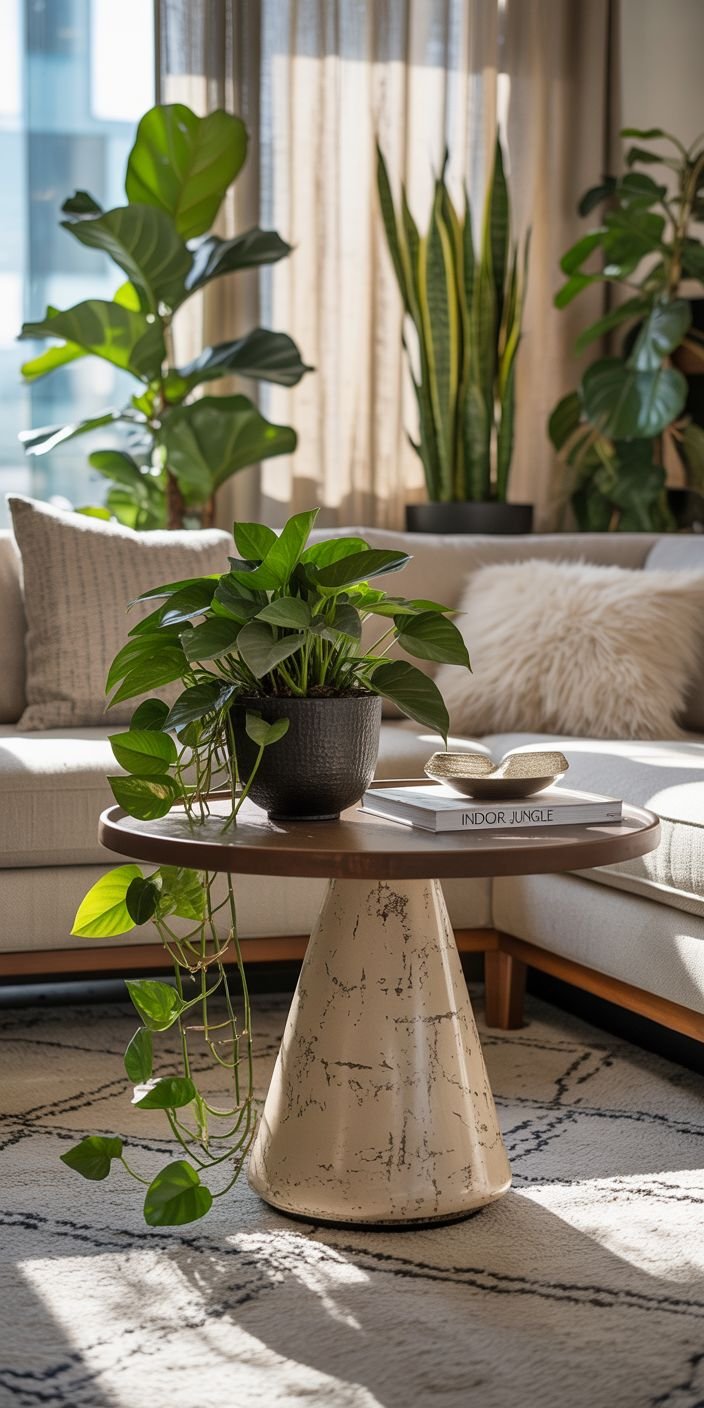
21 DIY Plant Stand Ideas That Make Your Indoor Plants Look Like They Belong There
Disclosure : This post may contain affiliate links or paid partnerships. I may earn compensation if you click a link or make a purchase, at no additional cost to you. See my disclosure for more info.
Your plants are fine.
The fiddle leaf. The pothos. The whole little succulent crew from the market.
All alive. All fine.
Fine is not what you were going for, though.
You were going for the version where the plants are displayed. Where they look like they were placed on purpose. Where your room has the kind of green, layered, alive energy you see in every apartment tour video.
What you have instead: plants on the floor. Or jammed on the windowsill with the candles and the mail and the things that never quite found a home. Or perched on a book stack that’s genuinely one watering session away from disaster.
The thing between where you are and where you want to be is a plant stand.
Just something that gets your plants off the floor and into the visual frame of the room.
The store options aren’t worth what they charge. Sixty, eighty, a hundred dollars for a piece of wood with legs? No.
These twenty-one ideas are better anyway. More personality. Lower cost. Actually buildable.
Let’s get into it.
1. The Thrift Stool Flip
Walk into any thrift store. Find a small wooden stool.
The older and more forgotten, the better.
Sand it down. Give it a coat of paint — any color that works in your space.
Done.
What you’ve created has something no store stand has: history. The worn edges, the slight imperfections from the brush, the evidence of a previous life.
That reads as interesting. For four dollars.
2. The Copper Pipe Trick
Three copper pipes. Three elbow connectors. One round wood top.
Join the pipes into a tripod. Glue the disc on. Let it set.
Total time: twenty minutes.
The result looks like something you paid sixty dollars for at a boutique plant shop.
Copper next to green foliage is one of those combinations that just works — warm tones make the greens look richer and more vibrant. Interior designers know this. Now you do too.
3. The Hairpin Leg Build
Four hairpin legs. One round wood blank. A few screws and fifteen minutes.
That’s a complete mid-century modern plant stand. The kind that costs sixty at West Elm and fifteen when you build it.
Stain the wood a dark walnut shade before attaching the legs. The contrast between dark wood and bright metal is genuinely excellent.
This is the project that will make people ask if you bought it. Tell them the truth. Both answers are good.
4. The Stacked Crate Tower
Two or three wooden crates. Stacked upright with alternating open faces.
Each crate is its own planting pocket. You get height, depth, multiple display levels.
Paint them all one color for a clean look. Leave them raw for a craftier feel. Either direction works.
This is the ideal solution for a bare corner that needs something happening in it.
5. The Macramé Hanger
One type of knot. Repeated about forty times. That’s macramé.
A basic four-cord plant hanger takes an hour with a beginner tutorial. The result: a hanging plant display that uses zero floor space, adds warmth and texture, and works especially well for trailing plants that look best when suspended and cascading downward.
Small apartments: this one is your best friend.
6. The Two-Dollar Statement Piece
One cinder block. One can of matte spray paint.
That’s the project.
Paint it. Let it dry. Set a plant on top.
The industrial-meets-organic contrast — rough, heavy concrete under something soft and growing — is a legitimate design technique that high-end interior stylists use on purpose.
You’ve just done it for two dollars. Don’t explain where you got the inspiration unless someone asks.
7. The Leaning Ladder
An old ladder leaning against a wall becomes a multi-level plant display instantly.
Each rung holds a pot. You get visual height variation, natural rhythm, and a display that fills vertical space without taking any floor space at all.
No old ladder in the shed? Build a simple version with two boards and a handful of wooden dowels. It doesn’t need to be perfect. Slightly rough-hewn is part of the aesthetic.
8. The Upturned Tomato Cage
Flip a wire tomato cage upside down.
Spray paint it. Set a plant on the top ring.
The open wire structure below creates an unexpectedly sculptural silhouette that looks deliberate and interesting rather than like a garden tool that wandered indoors.
Total cost: whatever tomato cages cost near you. Which is practically nothing.
Total reaction from guests: consistent curiosity about what it is and where you found it.
9. The Jute-Wrapped Tin
Large tin can. Natural jute cord. Hot glue gun.
Wrap the cord from base to rim in tight rows, securing with glue as you go. Fifteen minutes total.
What was recycling is now a warm, textured artisan planter that looks like a shop purchase.
Make three. Group them together in different sizes. The cluster effect is significantly more impactful than any single piece.
10. The One-Plant Shelf
One floating shelf at eye level. One plant. Nothing else on the shelf.
The empty wall around the plant does the work. It directs your attention to the plant and says: this was placed here on purpose.
One thoughtfully placed plant reads as more designed than five plants crammed together on a surface. Restraint is a form of confidence. This is that.
11. The Wood Slice Stand
A cross-section of tree trunk, sanded smooth on top and sealed with clear coat.
Every single one is different. The grain, the rings, the shape, the color — no two are identical. Genuinely unreproducible.
It brings the outside in without metaphor. It’s literally a piece of a tree. Set something dramatic on top — a monstera, a fiddle leaf, anything with presence — and you have a display that makes a room feel connected to something larger than itself.
12. The Pegboard System
A pegboard on the wall with hooks and small shelves wherever you need them.
Move things around whenever you feel like it. Add positions as the collection grows. Rearrange the whole display in ten minutes whenever the urge hits.
It’s the only display system that actually keeps up with an expanding plant collection. Nothing is permanent. Everything is adjustable. That’s exactly right for how plant collections work.
13. The Chair That Changed Jobs
The wobbly chair in the garage? Stop trying to fix it.
Remove the seat panel. Drop a pot into the opening. Let a trailing plant cascade down over the legs.
It’s no longer a broken chair. It’s a sculptural object with a story. An object that used to be one thing and is now something more interesting.
That transformation quality is what makes rooms feel alive and personal rather than assembled from a catalog.
14. The PVC Cluster
PVC pipe cut to five different heights. Small wood disc tops. Everything painted one unified color.
Grouped closely together, varying heights in a deliberate rhythm.
The uniform color treatment is what makes this work — the material disappears and you see only a sculptural plant grouping. Short, tall, medium, very tall, short. The rhythm is what makes it look designed rather than random.
Matte white, matte black, and sage green are all excellent choices depending on your space.
15. The Wire Geometric Frame
Thick-gauge wire, bent into a geometric cage shape with pliers.
A pot inside. The wire frame around it.
The structure is open, so it doesn’t block anything visually. But the precise geometric angles give it a strong graphic presence — like a picture frame for the plant inside.
Patience required. Results consistent. The finished piece looks like a considered forty-dollar purchase from a design-forward small shop. For the cost of some wire.
16. The Window Shelf Garden
A slim shelf fitted across the interior window frame. Small pots lined up across it.
Your plants get the best light in the house. Your window becomes a living green installation. Light filters through the foliage and changes throughout the day.
It also means you can grow herbs here. Plants and fresh basil from the same shelf. That’s what a double win looks like in practice.
17. The Garden on Wheels
A three-tier rolling cart filled with plants looks genuinely charming — like a small greenhouse corner in your home.
The wheels matter. Roll it toward the best light in the morning. Roll it back in the evening. Your plants follow the sun instead of being stuck where they look nice but don’t thrive.
Style the tiers with different pot materials and heights. It looks like you thought about it. Because you did.
18. The Wall Box Display
A simple open wooden box, mounted on the wall. A plant inside it.
The box creates a frame. Framed things read as intentional. The plant becomes an object on display rather than a pot that needed somewhere to go.
Three of these in a row. Evenly spaced. That’s an installation. People will say so. You can decide how much credit to take.
19. The Stack: Stool, Basket, Plant
No building required here. Just three objects, combined.
Woven basket. Low wooden stool. Plant in the basket, basket on the stool.
Three materials, three heights, three textures in a single small footprint.
Interior stylists call this layering. It’s one of the primary ways to make a space feel rich and considered. You just did it with thirty seconds of assembly and things you might already own.
20. The Ceiling Space Garden
Floor space: limited. Counter space: limited. Shelf space: limited.
Ceiling space: completely untouched.
A three-tier hanging wire basket set loaded with plants and hung near a window fills that vertical space with cascading greenery that filters and plays with the light in a way that nothing on the floor can achieve.
It uses the one surface nobody was using. It turns out that surface was the whole time.
21. The Book Stack Done with Intention
Books as a plant stand: wrong when it’s accidental, right when it’s deliberate.
Choose hardcovers with coordinating spine colors. Stack them squarely. Saucer on top. Plant on the saucer.
In a reading corner, a home office, or a study — where books and plants make natural companions — this looks completely intentional.
Because it is. That’s the whole difference.
The Rule That Changes Everything
One principle governs whether your display looks right or slightly off.
It’s proportion.
Large plant, small stand: looks precarious and wrong. Small plant, massive pedestal: looks lost and wrong.
Match the visual weight. Full, spreading plant needs a solid, substantial base. Small, delicate plant needs something light and minimal.
Get this right and everything else follows. The material, the finish, the color — all of it reads better when the scale relationship between plant and stand is balanced.
This is the single most important styling decision you’ll make.
The Trap to Avoid
You’ve seen twenty-one good ideas. Some of them clicked immediately.
Here’s what usually happens next: the link gets saved. The tab stays open. Life continues. Six months later, the plants are still on the floor.
Don’t do that.
Saving is not building. Pinning is not doing. The room doesn’t change until you actually make something happen in it.
You have the ideas. You have the weekend. The only missing piece is the decision to follow through this time rather than next time.
Go. Now.
Pick the one idea that felt most doable.
Not most impressive. Most doable.
Write down what you need. Get it this weekend. Spend one hour. Build it.
Put your plant on it. Step back.
Notice how the room feels different.
Not because you spent a lot. Not because the stand is complicated. Because you made something with intention and put it in the room with purpose — and that always shows.
Your plants have waited long enough.
Your room has waited long enough.
Go make it happen.
This weekend.